· 7 min
Forum, Discord, or Slack: pick the room before you invite anyone
Each community platform sets a different tone before a single message is posted. What Discourse, Discord, Slack and LinkedIn each do well, what killed the forum, and how to run the one you choose.
I ran a developer forum for a hardware machine-learning platform for close to four years. In its best year it answered thousands of questions and produced a handful of people who knew the product better than some of the staff. Today it is nearly silent. Nobody did anything wrong; the room stopped being the right room.
This post sets out what each platform signals, from having run all of them, so you can pick the room before you invite anyone into it.
Why it matters
The platform you pick sets the tone of a community before anyone has typed a word. It decides whether people arrive as colleagues or as members, and whether an answer given today can be found next year.
Get it wrong and the cost is the thing a community is for. The questions still get asked, just somewhere you cannot see them, answered by people you cannot thank.
Each room signals something different
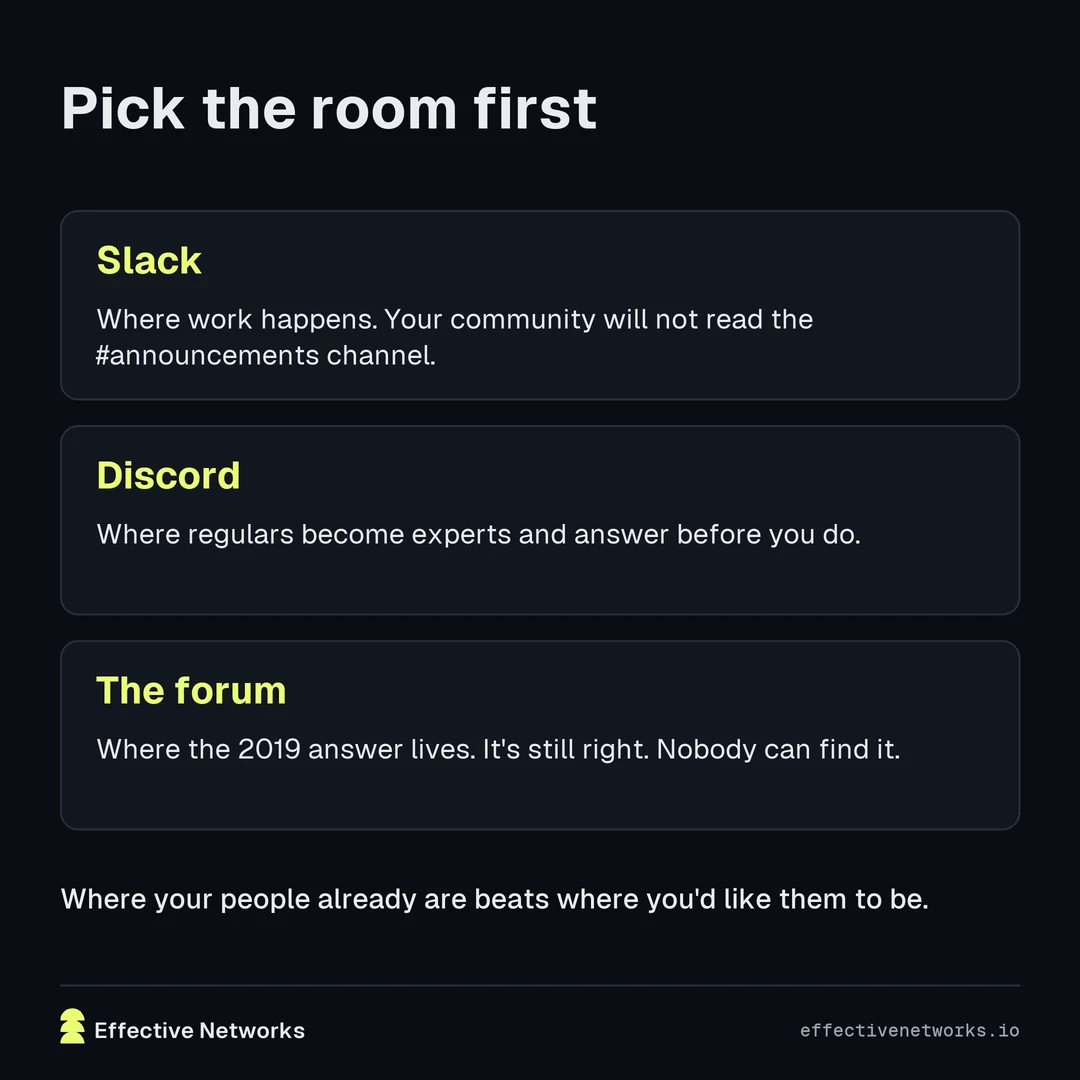
Slack and Teams mean work. People arrive with their work identity, expect a reply from a colleague, and leave when the project ends. Slack is the right room for a customer's engineering team and yours, for a partner integration, or for a paid programme with a service-level agreement (SLA). It is the wrong room for a public community: the free-tier history disappears, nothing is indexed by search, and the notification model makes people resent it.
A forum (Discourse and its relatives) means public, durable, searchable. Questions get answered once and found a thousand times. It is the only one of these platforms that compounds: a good forum thread from three years ago still pays out today, through search. The cost is that it feels formal. People draft a forum post; they do not fire one off. It is also the room where advocates learn the product.
Discord means an exclusive community. Not exclusive in the sense of gated, but in the sense of belonging. The people in it chose to be there, they use a handle rather than a job title, and the tone is closer to an internal expert network than a help desk. It is fast, it is personal, and it is where the questions people are embarrassed to ask get asked.
LinkedIn means visibility. It is not a community platform, but it has become where a lot of a developer community now is. Practitioners moved there to be seen, and if you want a read on what your community thinks, it is now often the fastest place to get one. It is terrible for support and for anything that needs to be found later.
What killed the forum: good docs and a faster room
Two things, and neither was a competitor forum.
First, the docs got good. Most questions that once became forum threads now get answered by a search of the documentation, or by an assistant trained on it. The forum's core job, first-line answers, was absorbed.
Second, Discord took the conversation. Once a Discord existed, the quick question ("is this normal?") went there, because the answer came back in minutes from a person, not in a day from a thread. The forum kept the long-form troubleshooting for a while, then lost that too as the experts moved with the traffic.
The forum did not die of neglect. It died because the two things it was good at were each done better elsewhere. If you are launching one today, be honest about what it will do that docs and a chat room will not. Usually the answer is "the searchable archive", and that is a fine reason, but it means treating it as a knowledge base with a comment section, not as the community's living room.
Why Discord works when it works
Discord gives people a place to ask the stupid question. If you run a skills programme, a course, or any kind of learning path, your participants have a long list of questions they are afraid to ask in a recorded webinar or in the comments of a YouTube video. A channel with a handful of peers and a moderator is where those questions surface, and where the drop-off you would otherwise see at week three gets caught.

With the right setup, Discord will also generate your experts. A few people answer a lot of questions, get recognised for it, get a role, and start answering before staff get there. Within a year they will almost run the server for you. This does not happen by itself: it needs roles that mean something, staff who thank people publicly, and a clear line on what volunteers are not expected to do (anything involving a customer's account, for instance).
A hackathon is a good way to boot a new Discord. It gives the first two hundred people a reason to be in the room at the same time, and a shared thing to talk about. Servers started without that moment tend to sit at forty members and a bot.
Where to send people from the content you publish
If you are publishing recorded talks or a skills series and getting single-digit views with no comments, turning off the comments is not defeatist. It is a routing decision. YouTube comments are a room you do not control, with no memory, that most viewers never read. Point people at the room you do control (the Discord channel for the series, or the forum thread for the episode) and you will get the same handful of comments, plus a conversation that persists and that the next viewer can read.

Match the room to the people you want in it
- Enterprise customers and partners belong in Slack or Teams, in shared channels, with an owner on each side.
- A public product with a long tail of technical questions needs a forum as the archive, with a Discord for the conversation, and a rule about which questions get moved where.
- A learning programme, a challenge, or a small product with an enthusiast base suits Discord, started with an event, with volunteer roles designed from day one.
- For reading the room, use LinkedIn and your own posts there, treated as a listening tool rather than a channel to manage.
The takeaway: member count tells you nothing
Pick the room for the job it has to do, then measure it on activity, not size. Decide before launch how you will measure it. Active members in the last thirty days, questions answered by the community rather than staff, and median time to first answer are the three numbers that tell you whether the room is alive. We cover the rest of the model in how to measure a developer community programme.
The first step comes before any platform: write down the one job the room has to do, whether that is answers, belonging, visibility or a shared channel with a customer.
Choosing or restructuring a community platform? Book a call; we have run every one of these and will tell you which one you do not need.